Gelato Strain in South African Conditions: Where It Finishes and Where It Rots
Royal King Seeds Editorial Team
Cultivation and editorial team, Royal King Seeds South Africa

Gelato is a strong choice in the Western Cape, the Northern Cape and most of the Highveld, and a risky one on the KwaZulu-Natal coast or the Garden Route unless you grow it under cover. The reason is structure, not potency: Gelato makes short, hard, tightly packed flowers, and dense flowers plus humid nights equal botrytis, the grey mould that hollows out a bud from the inside.
Where flowering happens dry — the Cape's dry summers, the Karoo, the Highveld between thunderstorms — Gelato finishes clean, colours up and rewards the grower. Where the air stays wet through February and March, it does not.
What follows applies to outdoor and greenhouse growing in the nine provinces, and to indoor growing where you control humidity yourself. Everything about timing below is Southern Hemisphere: plant out September to November, harvest March to May.
Where Gelato comes from, and what that inheritance predicts
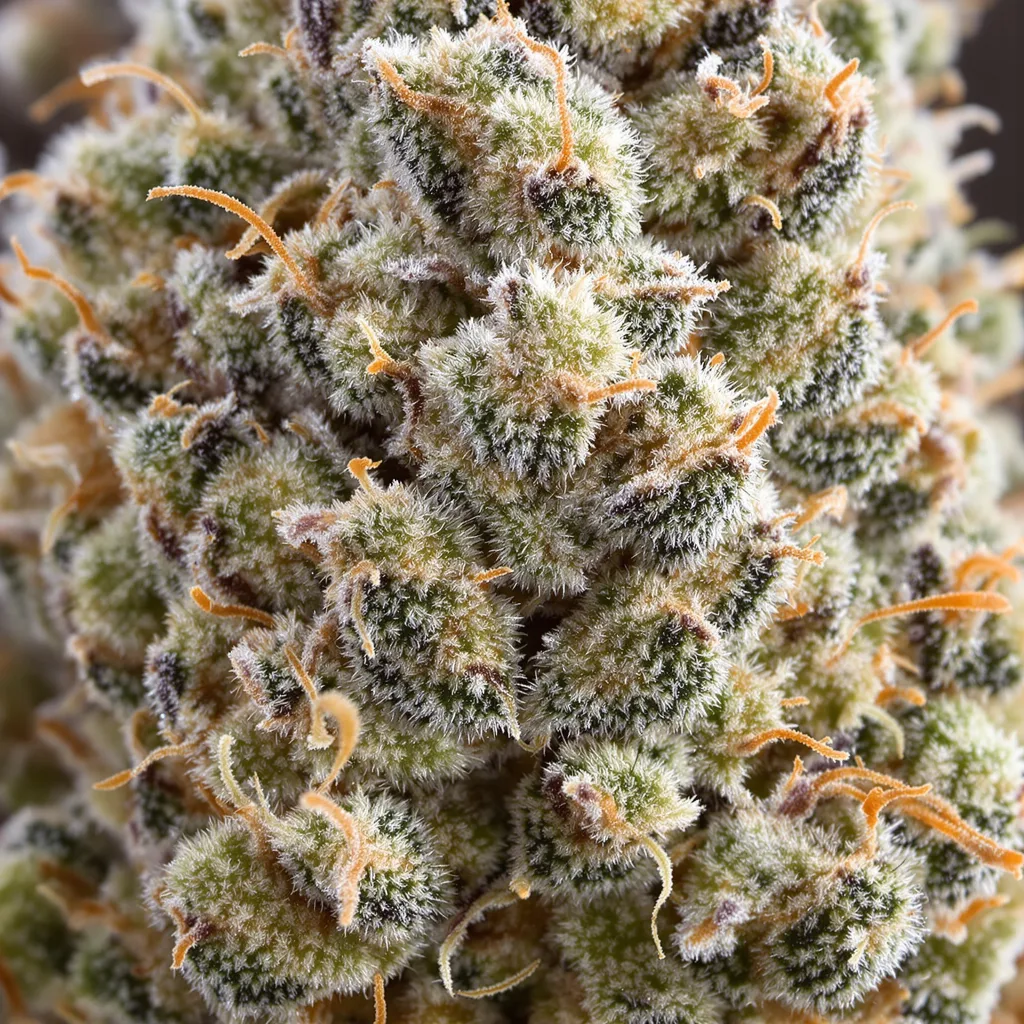
Gelato is a Bay Area cross of Sunset Sherbet and a Thin Mint phenotype of Girl Scout Cookies, bred indoors, for indoors, in a climate nobody in South Africa gardens in. That lineage matters practically. Cookies-family plants are indica-leaning hybrids with short internodes — the gaps between branch nodes are close together — so flowers form in overlapping clusters rather than the spaced, airy spears you get from a sativa-leaning landrace like Durban Poison.
Indoors that density is the whole point: it concentrates weight and resin in a small canopy. Outdoors in a summer-rainfall province it becomes the plant's main liability, because water that lands in a Gelato flower cluster in February does not dry out quickly. The numbered selections you see for sale — Gelato 33, Gelato 41, Gelato 44 — are different phenotypes selected out of that same family, and they differ more in colour, terpene profile and finishing time than in the basic architecture. All of them are dense.
The characteristic that decides everything: flower density
Before you look at reported effects or terpenes, decide whether your site can dry a dense flower. Gelato colas hold internal moisture after rain or heavy dew, and the interior of a cola stays humid for hours after the surface looks dry. Botrytis starts in that interior, usually at the point where a leaf petiole enters the bud, and by the time you see the grey fuzz on the outside the damage is done.
Three things reduce that exposure and none of them change the genetics:
- Airflow. Strip the lower third of the plant, open the centre, and space plants further apart than feels necessary. A metre between plants in KwaZulu-Natal is not generous, it is the minimum that lets wind through.
- Cover. A simple clear roof that keeps rain off the canopy while leaving the sides open does more for Gelato in Mpumalanga or the Eastern Cape than any spray.
- Finishing earlier. An autoflowering Gelato started in September can be off the plant before the worst of the late-summer humidity.
How Gelato behaves province by province
Western Cape. This is the best home for Gelato in the country. The rain falls May to August, so flowering from February onward happens in dry, bright, hot conditions and the mould pressure that limits the rest of South Africa barely applies. The real problem is the south-easter, which runs hard through summer across the Peninsula and the Boland and will snap a branch loaded with a dense Gelato cola. Stake early, keep the plant short with low-stress training — bending and tying branches rather than cutting them — and plant out September to October once the winter rain has eased.
Highveld: Gauteng, Free State, North West. Gelato does well at 1 200 to 1 800 m. The intense ultraviolet light and big day–night temperature swings bring out the violet and magenta colouring the Cookies family is known for, particularly in the last two weeks. Two things bracket the season: plant out in October after the last frost, and get the plant off before the first frost in autumn. Thunderstorms from November to March are the second issue — hail will shred a plant in ten minutes, and a Gelato that takes a soaking in late February needs wind on it within a day.
KwaZulu-Natal and the subtropical coast. This is where Gelato struggles. Warm nights, high overnight humidity and summer rainfall through the entire flowering window make it bud-rot country, and dense Cookies genetics are the worst possible shape for it. If you want to grow Gelato in Durban or on the North Coast, grow it under a roof, in a pot you can move, with fans. Otherwise choose open-structured genetics suited to outdoor humidity instead.
Lowveld: Limpopo and Mpumalanga. Frost-free and long, but midsummer heat stalls Gelato — above roughly 32 °C the plant stops putting on flower weight and starts stretching. Shade cloth over the hottest hours and airflow through the flowering weeks matter more than feeding here. The Mpumalanga escarpment is cooler and considerably wetter than the plains below it, which shifts the problem from heat back to mould.
Northern Cape and the Karoo. Mould pressure is negligible and light is never the constraint, so Gelato finishes hard and resinous. Water is the whole game. Nothing finishes outdoors here without irrigation, and Gelato's dense flowers will still cook if afternoon temperatures sit in the high thirties without shade.
Eastern Cape and the Garden Route. The transition zone. Rainfall shifts from winter-dominant in the west to summer-dominant in the east, and the Garden Route coast gets rain all year with no dry season to plan around. Gelato is a greenhouse plant here, not an open-field one. Plant out September to October, harvest March to April.
Timing a photoperiod Gelato against the South African season
A photoperiod Gelato — one that flowers in response to shortening days — will start flowering outdoors after the December solstice, generally from late January into February depending on your latitude, and runs roughly eight to nine weeks of flower from there. That puts harvest in late March to April across the Highveld, the Cape and the Karoo, and April to May in the lowveld and on the KZN coast.
Work backwards from the risk, not from the calendar. On the Highveld the deadline is frost, and frost dates vary by site — a low-lying Free State farm frosts weeks before a Johannesburg suburb. In the summer-rainfall provinces the deadline is the last decent run of wet weather. If those two dates leave you no comfortable window, an autoflowering Gelato 33 removes the daylength dependency entirely: it flowers on age, roughly ten to eleven weeks from sprout, so you choose your own harvest date by choosing your sowing date.

Feeding: Gelato punishes a heavy hand
Gelato is not a hungry plant and reacts badly to being pushed. Too much nitrogen in flower gives you dark, clawed leaves, soft growth and flowers that hold water — exactly what you do not want in a dense cultivar. Feed lighter than the bottle says and increase only if the plant asks.
What Gelato does want is calcium and magnesium, and it will show deficiency readily: rust-coloured spotting on the middle leaves, or interveinal yellowing in fast growth. Growers on reverse-osmosis or very soft water see this first. On the Highveld, where light intensity drives fast transpiration, magnesium demand climbs in midsummer. Coco coir growers should supplement cal-mag from the start rather than waiting for symptoms.

Which Gelato to choose for your site
| Variety | Type and timing | Structure | Best suited to |
|---|---|---|---|
| Gelato 33 Auto | Autoflowering, roughly 10–11 weeks seed to harvest | Compact, single main cola with short side branches | Growers who need to dodge a specific weather window — KZN summer humidity, an early Free State frost, or a balcony with limited space |
| Gelato 44 Feminised | Photoperiod, roughly 8–9 weeks of flower | Medium height, strong lateral branching, very dense flowers | Western Cape and Northern Cape outdoor, or any indoor tent where humidity is controlled |
| Gelato Cake Feminised | Photoperiod, roughly 8–9 weeks of flower | Squat and bushy, Wedding Cake influence, dense to the point of needing defoliation | Indoor growers chasing weight per square metre; poor choice outdoors east of the Cape |
Yields depend far more on pot size, root run, light and season length than on which Gelato you pick, so treat the differences above as differences in shape and timing rather than in output. If you are choosing between families rather than within one, the strain finder filters by climate and season length.
Who should not grow Gelato
Skip Gelato if you are growing outdoors and uncovered on the KwaZulu-Natal coast, on the Garden Route, or on the Mpumalanga escarpment — the flower density is the wrong tool for those climates, and you will spend the last month cutting rot out of colas.
Skip it if this is your first outdoor grow and you have no way to keep rain off the plant, because Gelato gives you very little margin in the final three weeks. Skip it if you want the tallest, heaviest plant on the property; Gelato is a medium-height, medium-frame plant that concentrates rather than sprawls, and cultivars selected for bulk will outweigh it outdoors. And skip it if you feed heavily by habit — Gelato does not reward it.
Choose it if you grow in the Western Cape, the Northern Cape or on the Highveld outdoors, or in any tent where you set the humidity, and you want tight, resinous, often purple-tinged flowers with the reported dessert-sweet, creamy character the Cookies family is known for.
Common questions
When do I plant Gelato outdoors in South Africa?
Plant out from September to November depending on your province: September to October in the Western Cape once winter rain eases, October on the Highveld after the last frost, and September to November in the lowveld and KwaZulu-Natal. A photoperiod Gelato planted then will flower from late January or February and harvest from late March to May. Overseas guides give March to May as planting time, which is the Northern Hemisphere calendar and six months out of step here.
Will Gelato get bud rot in South Africa?
It depends entirely on where you are. In the Western Cape, flowering happens during the dry summer because the rain falls May to August, so mould pressure is low. In the summer-rainfall provinces — most of the country — rain falls October to March, straight through flowering, and Gelato's dense buds hold that moisture. KwaZulu-Natal's humid coast is the highest-risk area in the country for a cultivar of this structure.
How tall does Gelato grow outdoors here?
Gelato is a medium-frame plant that does not stretch dramatically, but final height depends on pot size, how early you plant and whether you top it. In the ground, planted in October in Gauteng, expect something you can still reach the top of; in a 20-litre pot on a Cape Town balcony, considerably less. Low-stress training keeps it under the wind, which matters more in the Cape than the height itself does.
Is Gelato better grown indoors or outdoors in South Africa?
Gelato was bred indoors and it shows — under controlled indoor conditions you set the humidity, so the density that causes trouble outdoors becomes an advantage. Outdoors it is genuinely good in the Western Cape, the Northern Cape and on the Highveld, and genuinely difficult in the humid subtropical east.
Is it legal to grow cannabis at home in South Africa?
On 18 September 2018 the Constitutional Court, in Minister of Justice and Constitutional Development v Prince, decriminalised the use, possession and cultivation of cannabis by an adult in private. The Cannabis for Private Purposes Act 7 of 2024 was signed into law on 28 May 2024 to give legislative effect to that judgment, with different sections commencing on dates fixed by the President, so not every provision is necessarily in force as you read this. The Act concerns private adult use and cultivation — commercial dealing remains an offence, and the judgment did not legalise trade.
Nothing in either the judgment or the Act permits use by a person under 18 or use in public. This is general information and not legal advice; read the Act itself and speak to a qualified professional about your own position.
If you grow in the Western Cape, the Northern Cape or on the Highveld, plant a feminised Gelato in September or October, stake it before it needs staking, and feed it lighter than you think you should. If you grow anywhere the air stays wet through February — the KZN coast, the Garden Route, the escarpment — either put a roof over it or pick an airier cultivar and keep Gelato for a tent.
Related Articles
Ready to Start Growing?
Browse 1,677 cannabis seed varieties with discreet shipping to addresses in all nine provinces and our sourced grow figures.
Shop Cannabis Seeds